01 / Expert source
01people with first-hand
operating knowledge
Docs, interviews, examples, exceptionsoperating knowledge
SOPs as infra
Describe the work. Create a new SOP, execution checklist, and OpenAI tools JSON with guidance on when to call each tool.
Open the SOP creatorClick to open the creator · No account required
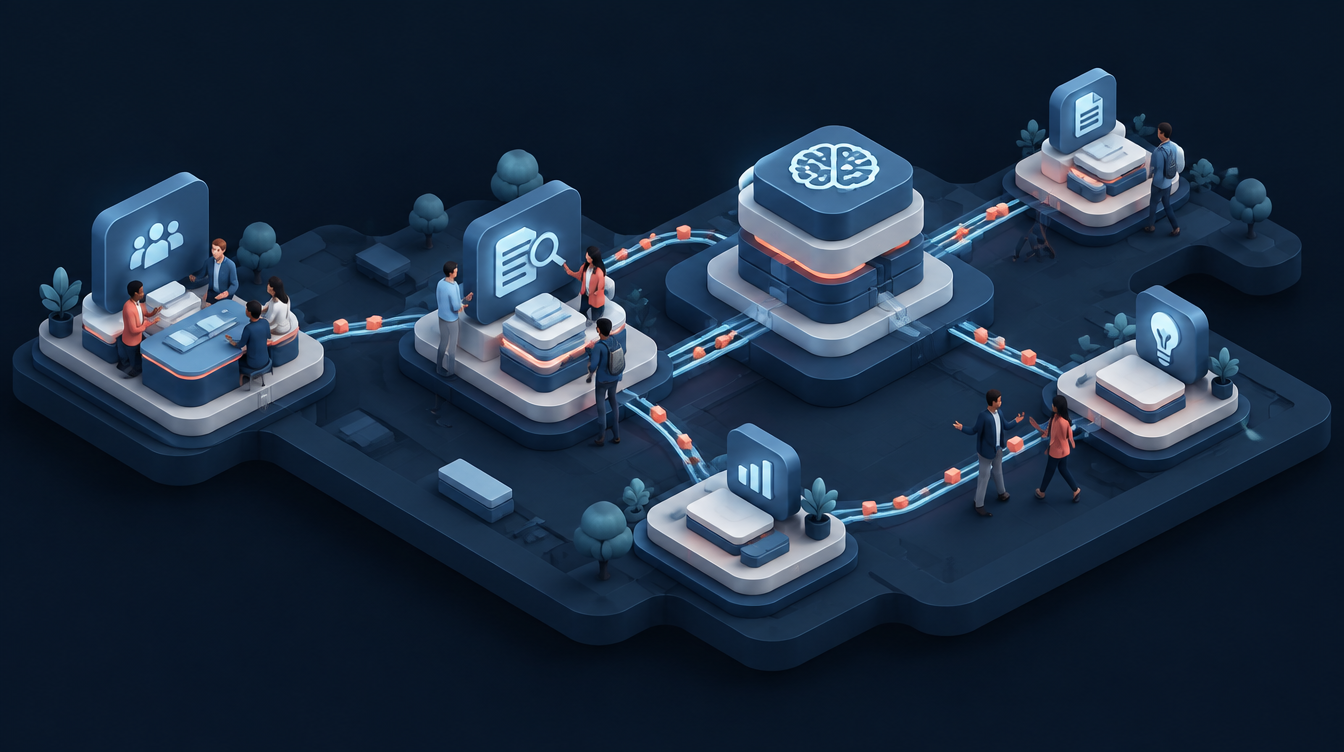
A large isometric workplace spanning nine connected neighborhoods, with five office departments, two glass meeting rooms, a table-tennis corner, a city post-and-call center, assembly line, delivery truck, and walking courier. A blank isometric browser window takes the place of the central knowledge platform while animated data paths enter and leave it.
COVERAGE / ALL KINDS OF WORK
Every role has a different rhythm. The same clear structure carries the trigger, owner, next action, and exception through each handoff.
Receive, scan, sort, and reconcile a shipment.
Schedule coverage, name a backup, and hand over the floor.
Route requests and make the next update accountable.
Check charges, receipts, and approvals against their source.
Confirm parts, access, and site contact before dispatch.
THE SOP STANDARD / FOUR CHECKS
A procedure should keep the original context and make its decisions visible from the first signal through the final handoff.
Every step can be traced to its original SOP or the expert who explained it.
Each handoff makes the accountable role clear before the work is passed along.
Describe the event or condition that tells a teammate it is time to act.
When the normal path fails, show what to hold, who to contact, and what to record.
RESEARCH NOTE / SOP-BENCH
Amazon Science’s SOP-Bench is a useful reference for evaluating agents: the work changes by industry, but every task asks the agent to follow a procedure, choose the right tools, and return a checkable result.
Assess trust signals and policy violations before routing a case.
Check account and system details before choosing a resolution.
Use shipment and safety-sheet details to determine handling class.
Reconcile maintenance records and component checks before release.
Classify the request and send it to the correct support path.
Review business details and risk signals against verification steps.
Register a patient while checking insurance and required information.
Locate and label objects in a driving scene using task instructions.
Classify submitted video and route moderation decisions.
Check package condition and compliance before the next handoff.
A RUN NEEDS MORE THAN A PASS / FAIL
The benchmark separates a correct decision from a clean run and from the tools used along the way.
Did the final decision match the expected outcome?
Did the run finish without an execution error?
When a run completed, was its result correct?
Did the agent choose and use the right tool?
Reference: the external SOP-Bench dataset card and its research paper. Benchmark performance is not, on its own, evidence of production readiness; the reference does not imply affiliation.
SOURCE → STRUCTURE → PROOF
Gather current SOPs and interview experts about the context and exceptions the page leaves out.
Shape each procedure around its source, owner, trigger, action, and exception path.
Benchmarks check whether the right action survives the messy parts of real work.
A FEW GOOD QUESTIONS
What we mean by an SOP, and how experts take part.
It names the situation that starts the work, the person or role responsible, the action to take, and what to do when the expected path breaks.
Yes. We are interested in the practical knowledge behind work across teams and industries, from logistics and customer support to finance and field service.
No. A checklist, notes, or a document is a useful starting point. The interview helps surface the context and exceptions that are usually left out.
Share your background and the SOPs you know best. If there is a fit, we invite you to a 10-minute video interview and pay $100 for your time.
The next station is yours
Share your SOP expertise in a 10-minute video interview. We pay $100 for your time.